Professor Buynevich on Investigating the Past through Geology
Kathrine
Thank you for joining me today. To start, would you mind introducing yourself, your field, and the main questions that you study?
Dr. Buynevich
Sure, hello, my name is Ilya Bunyevich, I'm Associate Professor of Earth and Environmental Science at Temple University in Philadelphia, and by training I'm a coastal geologist, so just a variety of disciplines that encompass coastal and marine geology, from evolution of our beaches and coastlines to some questions from the deeper sea, and then I go landward, sometimes I end up in the mountaintops, but mostly I'm in the dune fields or around rivers, now living in Pennsylvania, so even though I've been trained as a coastal geologist, I have research questions from the impact of life or biota during Earth history, so impact of animals on landforms and sediments, to sort of working on projects with archaeologists, that's actually a field of geoarchaeology, and then you have a lot of interdisciplinary and even multidisciplinary fields that I become part of, and sometimes it's the equipment I use, and sometimes these are the sort of expertise I have, and a lot of interdisciplinary teams have benefited from the research I've been conducting over the past 35 years.
Kathrine
So what originally made you interested in studying coastal geology?
Dr. Buynevich
Well, I grew up in the coastal city, along the coast of Black Sea in Ukraine, and I've always been interested in fossils specifically, so biology, geology, geography, but if you look at fossil, it's sort of everything is there, there's the ancient part to it, right, and then there's a bio part to it, and then it's encased in sediments, oftentimes understanding something about where you find these fossils and what they can tell you about the environments in which they formed, maybe that fossil was transported from a different environment, so by understanding not just fossils, but the context, you become, well, we're all by nature detectives, but you really become like a science detective trying to figure out, was it transported from a different environment?
How did it live? How did it die? Was it a tsunami storm?
So that was my interest, definitely, and, you know, sort of get interested usually by reading books with dinosaurs and so on, and then eventually, I remember once I entered the university, back then, we were doing our practice, sort of geological mapping practice along the beach, so you see all these people and some of my friends enjoying the beach, and here we are with my colleagues, students, fully dressed, measuring rocks along the outcrops along that coastline, well, these people are enjoying the beach, and wait a second, I'm actually enjoying measuring these outcrops, and I'm at the beach, so how about a job where I'm at the beach and at work at the same time?
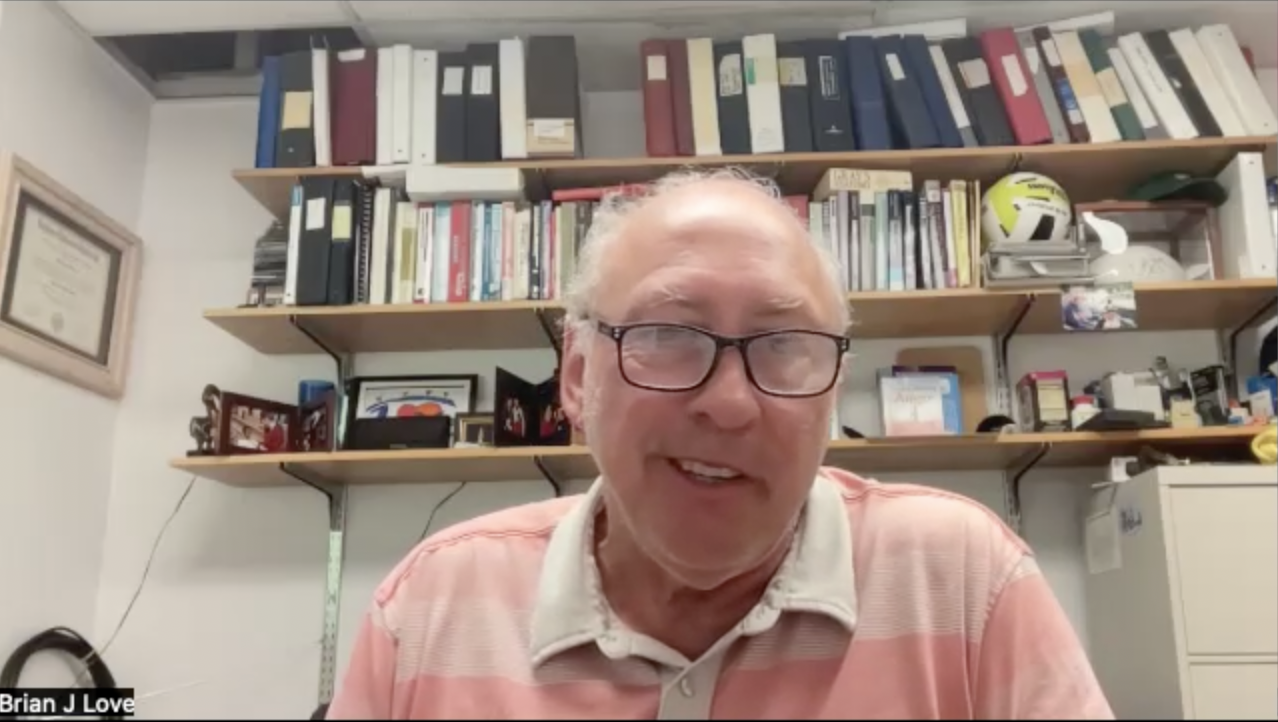
So yeah, I mean, oftentimes, we'll have some geophysical equipment or drilling equipment or we're digging trenches, but yeah, a lot of my work is along the shoreline, and I've enjoyed it, just like the background behind me in one of the islands in the Bahamas, that's one of our study sites, so for some people, it's a great screensaver, it is a screensaver, but it's also one of the sites where we did some work, and they have some ancient rocks right behind me, and then you have the beach right here, the modern beach, which eventually will turn into a rock, so we're studying what modern things look like, so we can then understand what happened thousands and even millions of years ago.
Kathrine
It sounds like an exciting place to work at, so as you mentioned, you are currently using georadar at, I'm guessing, a beach to help locate a fossil of a crocodile, so could you explain what exactly that means and what you were hoping to find?
Dr. Buynevich
Yeah, that was actually yesterday, so when we got in touch, that's what I would say, yesterday I was basically just getting out into the field after we've corresponded, so we were at the big fossil park in New Jersey, it's a beautiful museum now, Edelman Fossil Park and Museum, and they said that about 10 years ago, one of the volunteers found some fossils related to ancient crocodiles, so that's from the time of the dinosaur extinction, talking about 66 million years ago, but since then, that area was back then backfield, and they're not quite sure where it is, they know the general area, so I was bringing the radar, it's a very challenging context, because of the type of sediment on clay, the radar cannot look too deep, so I wasn't really even trying to find that fossil, it's extremely difficult, but trying to find the excavation from 10 years ago, where somebody was able to reach that fossil, so that reached up to the surface, so we're basically looking for some disturbed sediment, where somebody excavated and then filled it in, and then we were able to locate an interesting area yesterday actually, and I just heard from them that maybe next week they'll try to excavate there, you know, whether they find it at that exact spot, not sure, but we definitely found a place that seemed to have been excavated, and similar studies could be done at archaeological sites, and so you're basically looking maybe for places that have been excavated, and you know, that's something archaeologists do a lot when they're looking for grave sites, right, they're basically looking for holes in the ground that were backfilled, and whether there are bones or not, at least the radar allows you to find this anomaly, and find maybe potential spot, at least to start digging or radiate from that point, so hopefully I helped them out, plus we had some undergraduate students and volunteers involved yesterday, so at least folks in the field over a few hours, in 100 degree weather, at least we're able to get some experience in using a really high frequency geo-radar.
Kathrine
So next, your work combines geo-radar, sediment analysis, mineralogy, dating methods, and others, so could you walk us through how those different methods of investigation could come together in one investigation?
Dr. Buynevich
That's a great question, in fact I usually use all those specific aspects to see how they're all connected, so it's part of this integrated approach. An example, we find unusual dark metallic minerals, let's say under the beach, and those minerals have a magnetic signal, so then you can see them really well in the radar, which uses electromagnetic energy, right? So now you can map them out using radar before you even dig them out, you can also use their concentration to measure how magnetic these layers are, to tell you about the strength of the event that formed this unusual concentration, like storm or a tsunami on the beach, right?
Maybe a wind blowing away the light sediment, so for whatever reason they get concentrated. And then obviously use mineralogical expertise to find out which minerals are magnetic, some of them may be a little radioactive, not too harmful, but maybe radioactive, and then if they're thick enough concentrations of these unusual heavy minerals, oftentimes they may be even used in sort of for economic extraction, and people can make steel out of it, or maybe they're titanium-rich minerals, depending on what minerals are, they can actually have economically viable deposits, like ore deposits we call them, so you find them sometimes in modern or even ancient beaches. So this is an example how everything sort of comes together, our ability to detect, map these things using radar, then realizing the signal is due to unusual magnetic concentration that's related to specific minerals, all being concentrated in a specific place, and then, yeah, then we can use other methods, and then eventually dating, we can actually date, send around it to see how old they are, and then we can use these layers as actually time markers. So if I go along a beach and I find similar concentration, maybe it's formed all at the same time, I don't need to spend any more funds on dating these layers, because I know exactly what age that unusual layer is, so it becomes a time marker.
Kathrine
Yeah, cool. So next, what does a typical field work day look like for you, from arriving at the site to deciding what data to collect?
Dr. Buynevich
Sure, well, it could be something fairly straightforward, again, like, yes, the example just got down to that quarry site, and we set out an experiment with, again, we did our sort of mock excavation, just to see what it looks like, like excavation of a known size and depth, and then we went to that other site to see if we can find something similar, sort of what they were looking for, again, looking for that previously uncovered and then buried potential crocodile fossil.
So that was pretty straightforward, we sort of knew what we were looking for, but still I wanted to get sort of a site picture for everybody to see, that's what an excavation in this particular sediment looks like. Or it could be rather complicated, but it makes it challenging, but then the reward is as exciting, right? The more challenging the project, the more exciting the reward oftentimes.
So yeah, it could be a large operation on the research vessel, where you have to have everything come together, then you throw a lot of expensive, fine-tuned electronics into salt water, and it works somehow most of the time, and it's just amazing, and then you start finding, you know, ancient shipwrecks, let's say, at the bottom of the Baltic, Mediterranean, or Black Sea, and you're using, again, electronics that goes down several kilometers down in the dark, oxygen-deprived seawater, and everything works, and you find some interesting, in this case, archaeological and geological features, but that requires, you know, many thousands, even million dollars worth of equipment and coordination on scientists, so that's a lot of coordination, where everything has to fit in place.
Kathrine
So, what is the most unexpected or interesting object structure or other find that you have discovered during your field work?
Dr. Buynevich
Another great question, I mean, there are several, it could be geological in nature, again, like finding these unusual heavy mineral anomalies, but now finding them high in the dunes, they cannot be storms or tsunamis, there has to be a wind, so now you're looking at the geological evidence of an ancient, strong ancient wind that was blowing, let's say, thousand years ago, when the Vikings were traveling around northern Europe, so here I'm in the dunes in Lithuania, in the Baltic Sea, and I'm finding these layers, you know, there's several centimeters thick, but there's very unusual layers of dark, heavy minerals, they're all concentrated because of strong winds that remove our usual light, sort of, quartz that we're used to seeing on the beach, so if you grab a handful of sand on the beach and you keep blowing on it in your hand, eventually you'll see that the minerals in your hand will get darker and darker. So again, on the beach, that may happen by wave energy, but way high up in the dunes, just like you're blowing in your hand, it's the wind. So we're literally looking at a record of an ancient wind, and that was amazing, and then in these layers, as you start looking through them and you map them out using georadar, you start seeing unusual structures, and they're probably tracks of ancient animals.
So by themselves, you may argue it's not a great scientific discovery that there are animals walking around the dunes a thousand years ago, but once you realize that their action may disturb vegetation and cause a new activity of sand, so the sand begins to blow around simply because animals are removing vegetation, or it gives you some idea of ecology at that time, maybe interaction between animals and ancient humans, so it becomes a really, again, really interesting detective story.
And then other examples, more like paleontological, would be, again, finding fish fossils from 5,000 years ago in the ancient mud that was extruded onto the surface because giant dunes were moving across the landscape. So we would be very, very hard-pressed to find these fish fossils simply by digging or drilling, because usually that mud is, like, really deep, so it's very difficult to drill a small borehole and find ancient fish, right? Snails, maybe, because there are a lot of them, and they're scattered about the seafloor, but fish, you know, it's not easy to find just by drilling, but here the nature has helped us.
So these giant dunes, these are, again, in the Baltic Sea. As they move, they compressed the ancient mud so much that it got extruded onto the surface, like toothpaste, and everything, all the fossils in that mud, so including fish, are there. So for three or four years now, when I'm traveling to Lithuania, I go ancient fishing with my colleagues.
We'd go out, and every time we go out there, we find remnants of fish, and then we radiocarbon date them, and they're dating between 4,000 and 6,000 years old. So again, these are the fish that some of the ancient people were eating. Also tells you about ecological situation, right, environmental conditions, salinity, temperature of that area.
Kathrine
I mean, you're definitely better at fishing than I am, if you're able to catch them every single time you go out. So next, what do people most often misunderstand about geology, or what geologists actually do?
Dr. Buynevich
I wouldn't say it's misunderstanding so much. It's more of a narrow view, maybe, of geology, and again, we can use an example. If you ask a hundred people on the street, like, describe a geologist or pick a geologist out of a set of pictures, most of the time, even today, though people get more and more, you know, in tune of what scientists do these days, but even today, they'd say, okay, it has to be somebody, usually with a beard and a geological hammer going up the volcano, right, or somewhere in the remote setting, hitting rocks with a hammer, or oil and gas, right? Geologists help find oil and gas, and then it's just sort of, what about people studying ancient climate? Well, those are paleoclimatologists, but they're also geologists, right?
Geology just means, if you translate it, earth science. So all those paleontologists, as I am, coastal geologists, sedimentologists, people who study sediments, there are coal geologists, there are carbon geologists, a variety, so it's a much more diverse field of study, and then a lot of interdisciplinary studies, like, again, geoarchaeology, and so on. Geophysics, obviously, only using methods to study everything from deep earth to something super shallow, as we discussed.
So I guess it's more of a narrow understanding, but then you just have to say, well, since everything around us is either grown or mined, just pick up the phone and just say, well, it wouldn't work without, these wouldn't work without about two dozen rare earth elements and minerals and metals that are involved in making images appear on your computer screen, on your phone, and then you realize, yeah, at some point, geologists found these. We're just using more sophisticated equipment.
We can now extract gold from spoil piles. So when people are mining gold and just sort of throwing the unused sediment or rock to the side, now we can go and it's now viable to extract gold even from those spoil piles. It would be too expensive hundreds of years ago, but nowadays, right, we've figured it out.
And in the future, once it becomes viable to extract gold from seafloor sediment or from seawater, right, there's gold in seawater, it's just too expensive to extract it in such amounts that it'll pay for that extraction. So as new technologies develops, artificial intelligence, we can now maybe more efficiently find things. And then, you know, even now looking at environmental consequences of, let's say, contaminated groundwater, let's say you're not as interested in finding petroleum, but maybe you're trying to figure out where that petroleum-contaminated groundwater is moving, right?
So you also need geologists so they can figure out models and figure out how fast the water moves, which way it's moving, so you can prevent it from spreading into the water wells or looking for intrusion of salt water into coastal aquifers, right? You also, you can use ground-penetrating radar, right, georadar, so you can use it to map out areas with salt water and then see whether that salt water is intruding. That's one of the biggest issues along coastlines where a lot of people live is drinkable water, right?
Or, you know, even small nations in the Pacific, their number one issue is not even changing sea level climate, it's, you know, getting potable water to their residents. So those are all the issues that geologists help track and solve.
Kathrine
That's definitely a wide range of applications. And finally, what is one realistic step a high exploring geology, coastal science, or geophysical field research?
Dr. Buynevich
Yeah, I would say if something like earth science, environmental science is an elective, then definitely take it. I mean, obviously, if it's required, then by definition, students would have it in their schedule. But if you're choosing, and you can, you know, take earth science, take it.
If it's, if these are options between earth science versus environmental science, I would still take earth science, because then you can just simply apply it to environmental problems. It's more fundamental approach. And basically geology, they just don't call it geology in school, they just translate it right into English, I guess, and it becomes earth science.
So we still have biology. They don't call it life science, right? Everybody understands what biology means.
But for some reason, they started translating geology into earth science. But take one of those classes, go to a local museum, again, like in New Jersey, that new, beautiful fossil park and museum that I mentioned in Sewell, New Jersey, Adelman Fossil Park, that's a great place. And they have museum exhibits, all kinds of interesting, even virtual reality tours, and so on.
Interested for anybody from, from, I would say, K through 12, but for high school students, a lot of information, you can even get involved and volunteer. And, you know, even going to like a rock and mineral show and get interested. And again, coming back to sort of perception of geology, that's probably what most like high school students would think, right?
Like you go to a rock and mineral show or a fossil show, okay, that's sort of a classic geology. And it still is, because we don't have a groundwater geochemistry show, right? Usually we don't have, like for general public, we don't have a geophysics show, we have a specific scientific meetings, but something the general public can can attend.
Yes, so there are volunteered fossil digs, go to your natural history museum, like in Philadelphia will be, you know, the Natural History Museum, which is now Drexel University. And then, yeah, even go into a local rock and mineral show. That's a good start.
And then, then again, you get into the field through this, through fossils, rocks, minerals, then once you're in the sort of field of geosciences, then you can take your own path, whatever you're passionate about reconstructing ancient climate, ancient environments, looking at coastal erosion, rivers, like I have students studying the impact of resurging beaver population on local creeks. It sounds like something a biologist would study, but you know, they affect, right, the trees along the bank, which in turn then make these banks more vulnerable to erosion. So all the burrows by our groundhogs, all the trees that are felled by beavers, that's a geological process on a very large scale.
So again, it's a good example of this interdisciplinary study. And a lot of students can get involved. Maybe they like biology or zoology.
Sure, let's combine them. And then, you know, let's track dinosaurs. So it's a little bit of biology.
You're looking at ancient footprints. It's a little bit of geology now. So you have a science that combines them and it becomes again sort of tracking another detective story, which most humans enjoy.
Kathrine
That sounds very exciting. And this is also a great place to end. Thank you so much for sharing your work and advice with me.
I really appreciate your time. And I think students will learn a lot about geology from hearing your story.
Dr. Buynevich
Thank you and appreciate the opportunity.